Posts

Exploring the Future of Banking: How AI is Transforming Financial Services

Image
  Introduction: The banking and financial services industry is looking at a massive transformative effort with the integration of Artificial Intelligence (AI). These are machine learning , natural language processing, and robotics that acting as the main sources of improving the manifold functions of financial institutions, their methods of customer interaction, and risk management. AI can bolster the factors of productivity, customer satisfaction, and varied flexible services at one time for the banks and make them savvier in the newer tendencies of financial world. Key AI Applications in Banking: 1. Customer Service and Chatbots: AI-Powered Chatbots: Mobile, internet and artificial intelligent technology enabled virtual agents such as Bank of America’s Erica or Capital One’s Eno is revolutionizing customer support in banking today. For basic services that include checking balances, account transactions, and services relating to the card, these tools help in cutting the t...


Exploring the Evolution of Speech Recognition Technology: From Early Beginnings to Modern Applications

Image
  Introduction The technology of recognizing speech has enhanced much over the years and what used to be simple programs and applications have advance and complicated as per the current gadgets. This journey sums up changes in algorithms, computational capabilities, and blend of Artificial Intelligence and Machine Learning. Early Beginnings 1. 1950s: The Dawn of Speech Recognition Bell Labs: Even in the early 50s Bell Laboratories engineered what was recognised as one of the earliest kinds of speech recognition systems known as the “Audrey” that had the ability to decipher digits from an individual speaker. Research Initiatives: This period was based on the possibilities of transforming speech into text, most of which remained to be confined to a limited set of keywords. 2. 1960s-1970s: The Rise of Statistical Models   Harpy System: In 1971 Carnegie Mellon University, the university created The Harpy system, which could identify nearly 1,000 words through HMM te...

Unlocking Efficiency: The Power of Polyline Annotation Services in Annotating Maps and Floor Plans

Image
 Polyline annotation services have become rather important in the numerous fields with a special emphasis on annotating maps and floor plans. Here's a detailed look at their power and applications: What is Polyline Annotation? Polyline annotation entails drawing connected lines that enable one to label features in the concerned digital map or floor plan. This method can be easily and accurately used to define the paths, boundaries, and any other linear concepts. Applications of Polyline Annotation Services 1.        Geographical Mapping: Road Mapping: Paths or roads or highways can be represented by Polylines. Polylines can also represent areas such as fields and forests. They assist in navigation applications since they give out a definition of routes and traffic. Topographical Maps: Polylines draw contour lines, river or other geographical features that are helpful in the environmental research and land use planning. 2.   ...

Exploring the Role of Data Labelling Annotation Services in AI Development

Image
 AI entails various activities that are related to labelling and annotation services which is the process of marking the data that can be useful in defining and developing the systems. It is these services that are at the centre of using machine learning as they facilitate the preparation of large, clean, and well-annotated data samples for infusing into models. Here's a detailed exploration of their significance: 1. Foundation of Training Data Data Quality: However, such applications and approaches necessitate a high-quality training dataset to enhance the performance of AI models. In English, the general idea to it means that the type of information that users input into the system when training the program defines the type of model a signed out. Volume of Data: These include the Deep learning models, which functioning mainly depend on training that is conducted using large sets of data which have been marked or labelled. These prove helpful in overseeing and growing thi...

The Importance of Accurate Image Labelling Annotation in Computer Vision

Image
Image labelling annotation plays an important role especially in the field of computer vision where what the algorithm identifies in an image is expected to be correct. This works by assigning appropriate labels to pictures in reference to the objects and activities pictured therein. This includes such aspects as the accuracy of the annotations as they influence the performance and reliability of computer vision systems in different applications. Here are key points highlighting the importance of accurate  image labelling annotation in computer vision: Enhancing Model Accuracy 1. Training Data Quality: Datasets with the right labels are useful when training computer vision systems. The annotations are used by the models to identify and discriminate among the objects and hence errors or inconsistencies can make the models to perform poorly and determine the wrong items. 2. Reducing Bias: Annotating training data helps in reducing biases in training the data. Biases can occ...

Unveiling the Power of Point Cloud Annotation: A Game-Changer in Data Analysis

Image
 The Point Cloud Annotation is absolutely a revolutionary in data processing, mostly self-driving cars, robotics, augmented reality and the geographic information systems fields. Here's how it unveils the power of point cloud data: 3D Perception: Point cloud annotation assists the machines to comprehend and view the 3D world by annotating each inch point with some semantic information like object categories, boundaries, and attributes. This makes possible high accuracy and scenes understanding as well as objects identifying which are in a complicated environment. Training Autonomous Systems: The process of annotating point clouds is a very meaningful part of algorithm training for the field of autonomous systems which ranges from self-driving cars and drones and so on. Through classifying point clouds with objects such as pedestrians, cars, and traffic lights, the AI models can evolve to travel safely and instantly take rightful road-usage decisions. Precision in Object Det...

The Rise of 3D Lidar Annotation Services: Revolutionizing Data Labelling

Image
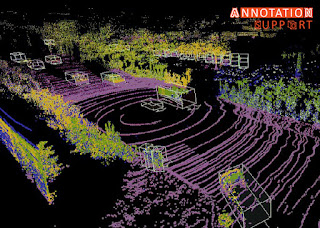
 The appearance of 3D LiDAR annotation services, particularly in the auto industry, therefore, signifies a substantial move in data labelling procedures that may be applied in areas such as autonomous driving, robotics, and augmented reality among others. Practically combining LiDAR technology, which has a precision to the nearest centimeter, and spatial awareness, gives it an advantage to create a 3D presentation of the environment in a very detailed manner. But the utilization of this data demands annotation by a team of humans. Typically, it takes a great deal of time and energy to make annotation that is accurate. The actualization of customized 3D LiDAR annotation services definitely turns the tide of this sector by providing adaptable options consistent with the particular complexities in LiDAR data. Here’s how they're transforming data labelling: Precision and Accuracy: LiDAR annotation service providers hire expert annotators who undergo rigorous training on defining an...